NoiseTrace › Meter

How loud is it, right now

A decibel meter that answers the question immediately — then keeps the numbers you need to explain it later.

What the meter shows

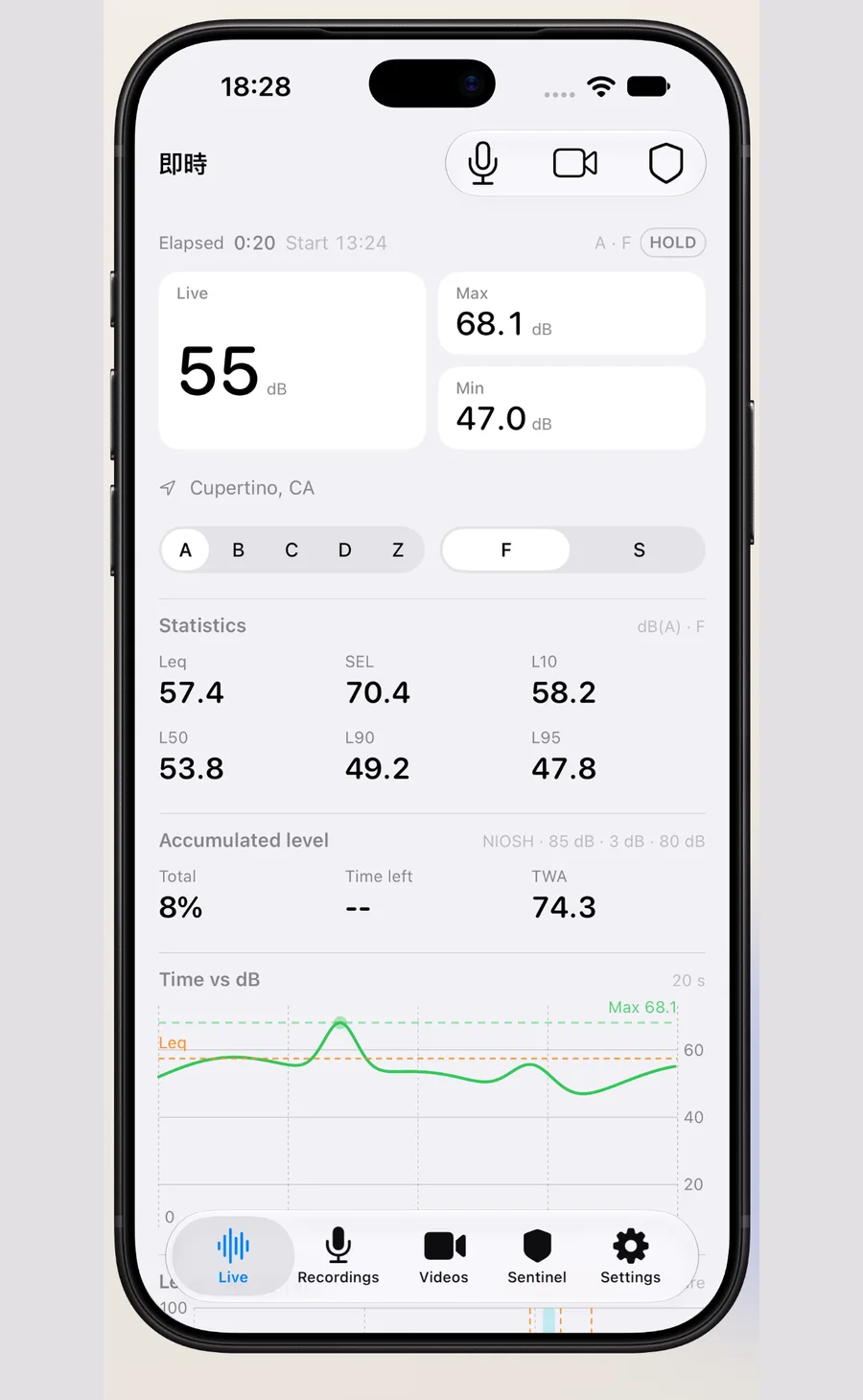
One screen: the current reading, how it has moved, and the statistics that make a single number meaningful.

🔢

Live, max and min

The large reading updates continuously. Max and min hold the extremes of the session, and HOLD freezes the current number when you need to read it without hurrying.

⚖️

Five weightings, two speeds

A, B, C, D and Z frequency weightings with Fast and Slow time weighting. Switching applies to the reading, the curve and the statistics together.

📊

Statistical levels

Leq, SEL and the percentile levels L10, L50, L90 and L95 — so you can say how loud it usually is, not only how loud it got.

⏱️

Timed measurement

Pick a duration and the measurement stops and saves itself when the time is up. Start it and walk away.

NoiseTrace live decibel meter screen

The curve, not the average

A single number hides the story. The level curve moves across a rolling 20-second window, so a bang, a door slam or a passing truck stays visible instead of being averaged into nothing.

Ten octave bands

The spectrum covers 31.5 Hz to 16 kHz. Low-frequency rumble from machinery and a high-frequency whine from a fan look completely different here — and they need completely different answers.

Accumulated level

A NIOSH-style accumulated level shows the dose of a session against an 85 dB criterion with 3 dB exchange, plus TWA and the time left at the current level.

Meter questions

Which weighting should I use?

A weighting is the usual choice for environmental and everyday noise. C weighting keeps more of the low end and is often used for machinery and peak checks. Z is flat. Many regulations name the weighting they expect — use that one when you compare against a limit.

Fast or Slow?

Fast reacts in about an eighth of a second and shows what is happening now. Slow smooths the reading and is easier to compare against a steady limit. Both are available at any time.

Why is my number different from another phone?

Microphones differ between devices, and none of them are calibrated by default. Two phones in the same room can read a few dB apart. Use one device consistently for trends, and calibrate against a reference meter when the absolute number matters.

Measure the room you are in

NoiseTrace is on the App Store now. Measure the noise, keep the context — free to download, records stay on your device.

Download NoiseTrace on the App Store

Questions or feedback? Email service@tonesight.com